Where we are and how to get here
How to get here?
The cemetery is located in the Wola district and covers an area of 43 hectares. It lies between Okopowa, Powązkowska, Tatarska and Jana Ostroroga streets. You can enter the cemetery from any side. You can park on the streets surrounding the cemetery or at Arkadia Shopping Center, just a few minutes' walk away.
Grave search
Map of Powązki Cemetery
The Powązki Cemetery search tool makes it easy to find a grave and learn about the lives of those buried there. Anyone can suggest changes to a biography or submit up-to-date photos of a grave, helping to keep the cemetery's knowledge base continuously updated.
No results match the given criteria.
Tours
Visit
Old Powązki
Discover Old Powązki up close—a place where the history of Poland is etched in stone. We invite you to explore together the story of this national necropolis, which for centuries has served as a pantheon of outstanding Polish women and men. As you walk along the cemetery paths, you can explore on your own, enjoying the peace and quiet of this place, or embark on a journey with a professional guide who will introduce you to extraordinary life stories and secrets hidden in the architecture of the tombs. We have over 50 different tour topics to choose from. Book free guided lessons for groups from primary and secondary schools.


History of Stare Powązki Cemetery
History of
Stare Powązki Cemetery
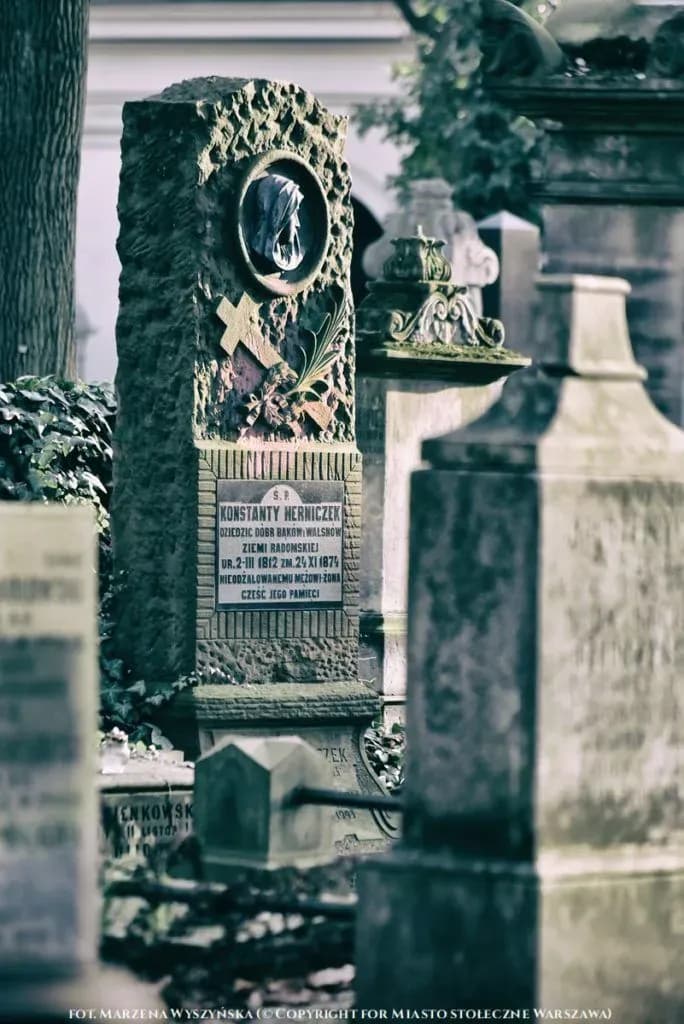
Powązki Cemetery has more than two hundred years of history. It is the history of Poland and Warsaw as they once were. The cemetery was founded in 1790 on land donated by the Szymanowski family. The solemn consecration, attended by the king, took place two years later, on 20 May 1792. At the time, the cemetery covered 2.6 hectares, and a church dedicated to St Charles Borromeo, designed by Dominik Merlini, and catacombs were built on its grounds. As time passed, the cemetery was expanded many times and now covers 43 hectares, divided into sections, rows and plots. Between them run paths lined with trees that today form the "green lungs of Warsaw."
The Second World War did not spare Powązki Cemetery. Around 20% of its gravestones were destroyed. The church was damaged, and the cemetery archives were burned during the Warsaw Uprising. Many tombs were used as shelters and weapons arsenals during this period. The cemetery grounds were also the site of many military operations, including the "Pawiak" operation in 1944, when the cemetery became an escape route for prisoners from Pawiak Prison.
Powązki Cemetery is the final resting place of more than a million people, including many distinguished Polish figures: actors, painters, scientists, professors, clergy, writers and military personnel. It is also home to the Avenue of the Meritorious, where Władysław Reymont, Jan Parandowski, Leopold Staff, Czesław Niemen and Jan Kiepura, among others, are buried. Walking through the cemetery, you can also stop at the graves of Frédéric Chopin's parents, poet Zbigniew Herbert, composer Witold Lutosławski, film director Krzysztof Kieślowski, Second World War courier Jan Nowak-Jeziorański, and Righteous Among the Nations Irena Sendler, who saved 2,500 Jewish children from extermination.
Today, Powązki Cemetery is primarily a historic site and a place of remembrance, as well as one of Warsaw's tourist attractions, visited by large numbers of tourists.